Contact Us

We offer both in person services based in Mission Valley as well as telehealth services via video-conferencing platforms to patients located in California.

We do not accept walk-ins. You must contact our Clinic Coordinator at 858-354-4077 or info@csamsandiego.com before visiting us on site.

CONTACT US

IF YOU WOULD LIKE TO INQUIRE ABOUT TREATMENT AT CSAM, PLEASE FILL OUT THE FORM AND A THERAPIST WILL CONTACT YOU TO MAKE AN APPOINTMENT.

You may also contact us via phone or email:

Phone: 858-354-4077

Email: info@csamsandiego.com

7860 Mission Center Ct, Suite 209
San Diego, CA, 92108

858.354.4077

At The Center for Stress and Anxiety Management, our psychologists have years of experience. Unlike many other providers, our clinicians truly specialize in the diagnosis and treatment of anxiety and related problems. Our mission is to apply only the most effective short-term psychological treatments supported by extensive scientific research. We are located in Rancho Bernardo, Carlsbad, and Mission Valley.

full banner.jpg

Blog

Read our award-winning blogs for useful information and tips about anxiety, stress, and related disorders.


THE POWER OF BREATHING

Jill Stoddard

by Annabelle Parr

Whether or not you struggle with an anxiety disorder, we have all found ourselves overwhelmed by stress or anxiety at some point.  We each have slightly different stressors that trigger our body’s natural stress response, but we all know what the response feels like: sweaty palms, racing heart, tense muscles.  This bodily reaction can feel overwhelming, as if it controls us.  It is easy to feel powerless to our biological response to stress, but we have more control than we think.

THE STRESS RESPONSE

Source URL: http://www.gestaltreality.com/2012/07/11/metabolic-diet-supplements-an-exploration/

Source URL: http://www.gestaltreality.com/2012/07/11/metabolic-diet-supplements-an-exploration/

Before we deem our biological reaction to stress bad, let’s talk about what happens and what purpose it serves.  When we get stressed out or anxious, our body begins preparing us to face threat.  Stress activates our sympathetic nervous system, triggering the fight-flight-or-freeze response.  This causes the sweaty palms, racing heart, panicky breathing and muscle tension (McGonigal, 2013).  We often look at the stress response as inherently bad, because it is not healthy to be in the fight-flight-or-freeze mode chronically (McGonigal, 2013).  However, it’s important to remember that when your heart starts racing or your palms get sweaty, your body is just trying to help prepare you.  Nevertheless, these sensations can feel overwhelming, and perpetuate our experience of anxiety.  So how can we calm ourselves down once this cycle is in motion?

DEEP BELLY BREATHING

Using our breath, we actually have the power to activate our parasympathetic nervous system.  The parasympathetic nervous system allows our body to “rest and digest” as opposed to the sympathetic nervous system’s fight or flight response (Hunt, 2016).  While “take a deep breath” is common advice, how we actually take that breath is important.  This is how to use the breath to calm down:

Source URL: http://goodrelaxation.com/2015/05/deep-breathing-for-headaches/

Source URL: http://goodrelaxation.com/2015/05/deep-breathing-for-headaches/

  1. Find a comfortable, relaxed seated position with your feet planted on the ground; alternatively, you can try breathing laying down.  Now begin to bring your focus to your breath.
  2. With each breath, your belly should rise as you inhale and fall as you exhale
  3. Your shoulders and chest should remain still.  If you notice your shoulders rise, or your chest move, drop the breath down to the belly.  Breathing into your chest is reminiscent of hyperventilating, which will only further activate your sympathetic nervous system (Hunt, 2016).
  4. Now focus on breathing into your belly for four counts.  Hold your breath for a second or two.  Now exhale for five counts and relax (Hunt, 2016).  Repeat this process, focusing on your inhalations and exhalations, and making your belly rise and fall.
  5. You may notice that your heart rate speeds up at first.  Don’t panic or give up.  Your body is not used to calming itself down, and is simply adjusting.  After a few cycles of inhaling and exhaling, you should notice your heart rate begin to relax. 
  6. If you begin to get distracted or thoughts pop into your mind, simply notice they are there and then come back to focus on the breath
Source URL: http://goodrelaxation.com/2015/05/deep-breathing-for-headaches/

Source URL: http://goodrelaxation.com/2015/05/deep-breathing-for-headaches/

See if you can practice doing four or five deep belly breaths a day.  Then see if you can work your way up to thirty seconds at a time.  Then maybe a minute.  Eventually, you will be able to sit in this space with your breath for a long period of time.

Being able to tap into your breath to find a calm, centered space, no matter where you are, is an invaluable resource.  This diaphragmatic breathing essentially turns off your sympathetic nervous system and turns on your parasympathetic nervous system (Hunt, 2016). 

This is not to say that you will never feel stressed again, or that you will never experience the fight-flight-or-freeze response.  But using deep belly breathing can help you to calm your body down and lessen the biological reaction to a stressful situation.

CSAM IS HERE TO HELP

If you or someone you love might benefit from acceptance and commitment therapy (ACT), cognitive behavioral therapy (CBT), or biofeedback for anxiety, depression, stress, or PTSD, or if you would like more information about our therapy services, please contact us at (858) 354-4077 or at csamsandiego@gmail.com.

REFERENCES:

Hunt, M. G. (2016). Reclaim your life from IBS: A scientifically proven plan for relief without restrictive diets. Toronto, ON: Sterling Publishing Co., Inc.

McGonigal, K. (2013, June). Kelly McGonigal: How to make stress your friend [Video File].  Retrieved from: https://www.ted.com/talks/kelly_mcgonigal_how_to_make_stress_your_friend?language=e

How To Listen When Someone You Love Is Struggling

Jill Stoddard

by Annabelle Parr

Life presents us each with challenges.  While it is often uncomfortable and painful to grapple with adversity, to experience this struggle and to feel pain is to be human.  At some point, we will all find ourselves in this place, as will those we love.  So how can we help each other?  How can we listen when someone we love is struggling, whether it is with a mental health condition or with a painful experience in his/her life?

 LET GO OF THE IMPULSE TO TRY TO FIX

Source URL: https://scott-williams.ca/2013/03/

Source URL: https://scott-williams.ca/2013/03/

It is painful to watch someone we care for struggle or hurt.  And it’s natural to want to take away her pain or try to fix the problem at hand.  However, despite our best intentions, trying to “fix” does not actually help.  It tends to make the person struggling feel as though she cannot share her pain, sadness, or anger.  Trying to “fix” sends this message: “I can’t handle seeing you in pain, so I have to make everything better.”  It also implies that it is not okay to feel sad or angry or anxious, and that these feelings should be avoided at all costs.

AVOID ADVICE

Just like our impulse to fix the pain, we also often believe that the best way to help is to offer advice.  But advice is usually not helpful for several reasons.

  1. If we offer good advice, our loved one will think that anytime he is struggling, he needs our instruction.

  2. If we offer bad advice or our advice doesn’t work as we hoped, our loved one can place the blame on us instead of owning responsibility.

  3. Advice takes away the gift of helping our loved one to realize that she knows herself best, and ultimately she is capable of navigating difficult situations herself. (Though, of course, she will always have our love and support).

LIMIT SHARING YOUR OWN SIMILAR EXPERIENCES

Source URL: http://www.lifehack.org/articles/communication/the-biggest-communication-problem-not-listen-understand.html

Source URL: http://www.lifehack.org/articles/communication/the-biggest-communication-problem-not-listen-understand.html

If you have had a similar experience or believe that you have felt the same way, you can share this with your loved one.  But don’t make it all about you.  Keep your story brief, and make sure the purpose of the story is to let him know that he is not alone.  Also, be sure to include that you understand that your experience, while maybe parallel in some ways, is yours, and you are not claiming to have experienced the exact same situation or feelings.  This allows him to feel comfort in not being alone, but also gives him space to communicate how his experience may be different.

If we shouldn’t try to fix the pain or offer advice, and we should limit how much we share of our own experience, what can we do to help?

REFLECT OR PARAPHRASE BACK TO YOUR LOVED ONE WHAT YOU HEAR HIM/HER EXPRESSING

This shows that we are listening, and gives us the opportunity to clarify that which we don’t understand fully.  While it may sound too simple to just reflect what our loved one is saying, it actually makes the person feel heard and understood.  It also offers her the opportunity to hear what she is expressing, and to clarify how she feels or what she wants.

USE NONVERBAL SIGNALS TO SHOW YOU ARE ENGAGED

Nodding and using eye contact and engaged body language shows that we are interested and open to what our loved one is sharing.  It gives him the space to express himself, and makes him feel heard.

SHOW EMPATHY

Empathy is: “I see that you are struggling and hurting right now, and I am so sorry.  I can’t fix it for you or take it away, but I will sit here with you and listen to your story.  As much as this hurts, it is okay to feel this way.”

Check out Brene Brown’s brilliant short on empathy.

Sometimes, all our loved ones need when they are in pain is to be heard; to be given a space with someone they trust to express how they are feeling.  Sometimes, however, they may need some extra support or professional help.

CSAM IS HERE TO HELP

If you or someone you love might benefit from acceptance and commitment therapy (ACT), cognitive behavioral therapy (CBT), or biofeedback for anxiety, depression, stress, or PTSD, or if you would like more information about our therapy services, please contact us at (858) 354-4077 or at csamsandiego@gmail.com.

REFERENCES:
Brown, B.  (2013, Dec 10).  Brené Brown on empathy. Retrieved from https://www.youtube.com/watch?v=1Evwgu369Jw


Hoarding

Jill Stoddard

by Jan E. Estrellado, Ph.D.

Most of us know someone who has difficulty throwing things away or cannot seem to stop him or herself from buying things at bargain prices, even when he or she doesn’t need them.  Extreme versions of these behaviors (i.e. “clinical hoarding”) affect up to 5% of the U.S. population (Samuels et al., 2008). What might cause an individual to let these situations get out of hand?  And what can that person or a loved one do to help that person change?

What is Hoarding Behavior?

According to the International OCD Foundation (https://iocdf.org/), hoarding consists of three related issues: (1) collecting too many items; (2) difficulty getting rid of items; (3) problems with organization.  Hoarding behavior can result in significantly limited living or work space, strained relationships with others, and in extreme cases, unsanitary or hazardous living conditions.

A person with hoarding behavior may experience severe distress when attempting to get rid of items.  That person may feel he or she need these things or that he or she will eventually use them.  Even if the person’s belongings are of little material value or use, the person feels unable or unwilling to get rid of the items. 

Hoarding behavior negatively impacts relationships.  If one person in a household hoards, others living in the home may resent and/or blame that person for the status of their living conditions.  While it may seem like an “easy solution,” (i.e., “Just throw those things away!”) this is a much more complex process for the person who has difficulty letting go of material things. 

Why Do People Hoard?

A person’s beliefs about his or her posessions, as well as the meaning he or she attributes to them, are core parts of why a person hoards (Steketee et al., 2003).  A person may be extremely sentimental about his or her items and feel as if losing the item is “like losing a friend.”  The individual may feel exceptionally protective over his or her belongings and become very defensive or territorial when another person suggests he or she get rid of them.  

Source URL: http://www.dcputnamconsulting.com/hoarding-keepdonatedump/

Source URL: http://www.dcputnamconsulting.com/hoarding-keepdonatedump/

Wheaton et al. (2010) discuss the difficulty some individuals have with tolerating distressing emotions related to hoarding.  The actions a person takes or does not take in order to minimize upsetting feelings is called avoidance.  For example, a person who feels upset when trying to give or throw something away might avoid those feelings by saving the item.  By keeping the item, the person can also avoid feelings of loss that might result from not having the item.  An individual who hoards might also feel a “high” when acquiring new items, so he or she continues to obtain new items, even if the item is not needed.

Getting Help for Hoarding

Seeking mental health treatment for hoarding behavior might be particularly difficult.  By the time the individual shows up at his or her therapist’s door, it is possible he or she has been hoarding for years.  Treatment might not have been the person’s first choice, but was perhaps at the strong encouragement of a concerned family member or friend.

Cognitive-behavioral therapy (CBT) is the treatment of choice to address hoarding behavior.  In a recent review of the scientific literature on hoarding treatment, Tolin and colleagues (2015) found that those who received CBT for hoarding had significant reductions in symptoms, especially with regards to a core feature of hoarding behavior, difficulty discarding.  A hoarding-specific version of CBT combines a number of different elements, including resolving the person’s ambivalence towards his or her hoarding behavior, and using exposure therapy to help the person directly confront his or her discomfort regarding discarding items (Tolin, Frost, Steketee, & Murdoff, 2015).

Another significant finding from the same study (Tolin et al., 2015) is that greater improvements with discarding symptoms were associated with greater number of therapy sessions conducted in the person’s home.  In-home sessions are more effective than office sessions because the therapist can be there with the client to help build new discarding and acquiring skills.

CSAM is here to help

If you or someone you love might benefit from acceptance and commitment therapy (ACT), cognitive behavioral therapy (CBT), or biofeedback for hoarding, anxiety, depression, stress, or PTSD, or if you would like more information about our therapy services, please contact us at (858) 354-4077 or at csamsandiego@gmail.com.


References:

International OCD Foundation.  https://hoarding.iocdf.org/

Samuels, J. F., Bienvenu, O. J., Grados, M. A., Cullen, B., Riddle, M. A., & Liang, K. Y. (2008). Prevalence and correlates of hoarding behavior in a community-based sample. Behaviour and Research Therapy, 46, 836 – 844.

Steketee, G., Frost, R. O., & Kyrios, M. (2003). Cognitive aspects of compulsive hoarding. Cognitive Therapy and Research, 27, 463–479.

Tolin, D. F., Frost, R. O., Steketee, G., & Muroff, J. (2015). Cognitive behavioral therapy for hoarding disorder: A meta‐analysis. Depression And Anxiety, 32(3), 158-166. doi:10.1002/da.22327

How Anxiety Affects Couples

Jill Stoddard

by Jan E. Estrellado, Ph.D.

Most of CSAM’s blogs focus on the experience of having a mental health condition, such as anxiety, depression, or PTSD.  This blog is a little different because it focuses on the impact of a mental health condition, anxiety, on couples.  What is it like to care for, live with, and support someone with anxiety?  What kind of strain might this cause in a relationship and what can couples do to sustain each other and their relationship?

Loving Someone with Anxiety

Partners or spouses of individuals with anxiety might experience feelings of helplessness.  When anxious loved ones feel intense fear (i.e., scared of having a panic attack or becoming severely preoccupied with worried thoughts) or avoid certain situations (i.e., not wanting to drive on the freeway or refusing to leave the home), partners may not feel there is much they can do to help reassure or calm them down.  When a partner does attempt to help ease his or her loved one’s suffering, those attempts (i.e., reassuring, problem-solving) may be rejected by the anxious individual.  This can be extremely hurtful and can lead to other intense feelings described below.  In addition, partners may try to help by offering to drive for the anxious partner, agreeing to skip a social event, or allowing the anxious partner to engage in compulsions so that he or she gets relief.  While these efforts are meant to be helpful, the avoidance partners are enabling actually contributes to and maintains the anxiety-related problems.   

The emotions that partners of anxious individuals can experience range and vary greatly.  They may feel anger and frustration that the anxiety inhibits their lives, and because their partner’s anxiety is outside of their control.  It is difficult to accept that a loved one may continue to feel anxious, regardless of the actions of the partner.  If a partner’s anger remains unresolved over a long period of time, this can turn into resentment, minimization, or blame.  Partners may feel overlooked or overshadowed by their loved one’s anxiety, perhaps feeling like their needs can’t be met when calming their partner down feels the most urgent.

Being the Anxious Partner in the Relationship

The partner who experiences extreme worry can easily feel guilt, shame, and embarrassment at their lack of ability to manage anxious feelings.  They may also feel misunderstood and alone.  These negative feelings, if not addressed or acknowledged effectively, might actually contribute to further anxiety.  If an anxious person feels his or her partner is getting frustrated, that person might shut down, withdraw from the relationship, or engage in unhelpful coping behaviors, such as smoking cigarettes or shopping excessively. When worry and stress take up a lot of space in a relationship, the anxious individual often feels responsible for his or her partner’s feelings of frustration, hurt, or helplessness.  These feelings of guilt or embarrassment compound the individual’s pre-existing feelings of worry, increasing the suffering of that person. 

It may be difficult for the anxious partner to know what he or she needs.  Perhaps he or she is too ashamed to ask for support when so much help has already been requested of the partner.  When a person experiences intense fear in the moment, it can be challenging to know what is helpful and perhaps even more challenging to communicate those needs effectively.  Intense fear, by nature, prevents a person from thinking logically or rationally and it can be tough to know how to reign one’s self in during those moments.

Sustaining the Relationship

What can a partner of an anxious individual do to help make the relationship work?  One crucial element is for the partner to make sure that he or she is able to maintain his or her own health and wellness.  A partner can feel guilty for taking care of himself or herself, especially knowing that his or her loved one may be suffering.  However, if both partners are suffering, especially over a long period of time, the relationship is no longer sustainable.  A partner might need to seek this support outside of the relationship.  Examples of support outside the relationship include trusted friends, family members, health providers, faith leaders, co-workers, and therapists.

In addition, a person may want to communicate his or her needs to the anxious partner, even if it is difficult.  If only one person’s needs are being met or paid attention to consistently, the relationship feels one-sided—another predictor of an unsustainable situation.  Asking for one’s needs to be met can also include discussing feelings and reactions to the partner’s anxiety.   While communicating feelings in an authentic, yet caring way, can be challenging, both partners might experience some relief and a greater connection, and the likelihood of resentment decreases.

An anxious individual may not want to wait until he or she experiences intense fear to know what help the partner can provide.  Rather, identify wants and needs during more calm or grounded moments.  When an anxious person knows what works, it is easier to engage his or her partner in a collaborative manner.  Having a “game plan” can ease some of the intensity of fear in the moment. 

Finally, as we say in Acceptance and Commitment Therapy, anxiety can have a place in the relationship, but it shouldn’t be “driving the bus.”  When anxiety appears to be controlling the direction of the relationship despite the couple’s best efforts, it’s time for one or both individuals in the relationship to seek outside support.

CSAM is here to help

If you or someone you love might benefit from acceptance and commitment therapy (ACT), cognitive behavioral therapy (CBT), or biofeedback for anxiety, depression, stress, or PTSD, or if you would like more information about our therapy services, please contact us at (858) 354-4077 or at csamsandiego@gmail.com.

Trauma and the Brain

Jill Stoddard

by Jan E. Estrellado, Ph.D.

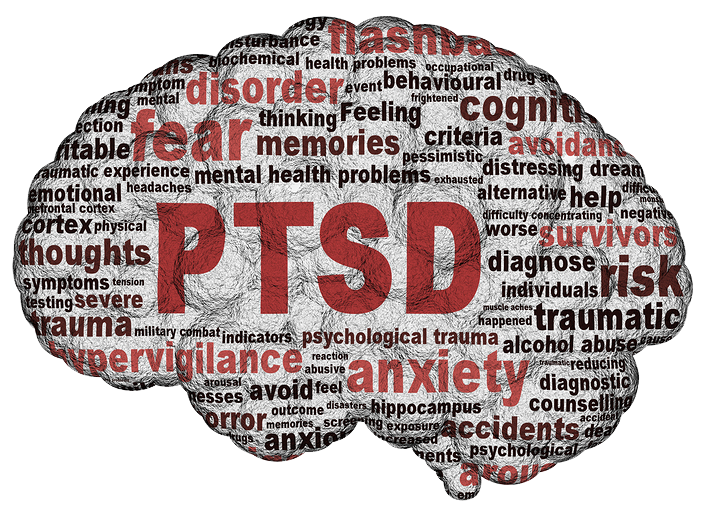
Responses to trauma can be found in both the mind and the body.  In the mind, people can experience unwanted, intrusive thoughts that remind them of the traumatic event.  They may feel misunderstood, isolated, and irritated with others around them.  Their beliefs about the world might change from a sense of safety and stability to one of unpredictability and danger.

In the body, people can feel “on edge,” like something bad is about to happen.  They may feel more anxious than usual, with symptoms of an increased heart rate, sweatiness, hyperventilating, difficulty focusing, or even a panic attack.  This is more likely to be true when they are exposed to an internal or external cue reminding them of the traumatic event, but for others, it can feel like it comes out of nowhere.

Trauma Response in the Brain

For an individual with PTSD, much of the response to trauma can be found by understanding what is happening in the brain. 

When something might be dangerous or threatening, it first goes to the thalamus, which is responsible for receiving sensory input (what you see, smell, taste, touch, and hear).  From the thalamus, it can go in one of two directions.  In the first direction, the “more sensible” direction, the sensory cortex accurately appraises the event as non-threatening and the hippocampus (responsible for memories), confirms or modifies this response.  This direction, while slower than the second direction, is often more capable of accurately assessing true threat.

In the second, “less sensible” direction, the thalamus sends signals to the amygdala (the emotion and fear center of the brain), which then goes to the hypothalamus, where action is taken to get relief.  This direction is often seen as tapping into the “fight or flight” response to fear.  While this direction is quicker and engages our survival mechanisms, it can also get us into trouble if our response is bigger than the situation calls for.

For individuals with PTSD, their brains often go in the second direction.  Their amygdala is on “over-drive” and cannot help them evaluate what is a true threat and what is not. 

Re-Training Your Brain

If your brain is trained to fire its amygdala at will, what can you do about it?  Enter the pre-frontal cortex.  This part of the brain is responsible for planning, strategizing, executing, reasoning, and decision-making.  At CSAM, we often encourage our patients with PTSD to engage their pre-frontal cortex in various ways: deep breathing, mindfulness practice, even coloring!  Any grounding activity that helps you stay in the present moment will help you engage your pre-frontal cortex.  These are effective short-term strategies for helping to manage an individual’s immediate PTSD-related anxiety.

Longer-term strategies include Cognitive Processing Therapy (CPT), Prolonged Exposure Therapy (PE), and Acceptance and Commitment Therapy (ACT).  These interventions have strong support in the scientific literature showing their effectiveness to manage PTSD.  In CPT and PE, patients “re-train their brains” to reduce their reactivity to distressing cues, often related to the traumatic event.  They continually re-write or re-tell the story of their traumatic event until they make new meaning of the trauma, learn that the trauma memories are not dangerous and discover that they can handle the upsetting responses that come with remembering the traumatic event.  In Acceptance and Commitment Therapy, patients practice mindfulness in order to understand what distressing thoughts they have when they recall the traumatic event.  They develop a willingness to engage with the memories and feelings of the traumatic event, so that they are “freed up” to live a life based on their values and what’s important to them.

CSAM is here to help

If you or someone you love might benefit from CPT, PE, or ACT following a traumatic experience, or if you would like more information about our other therapy services, please contact us at (858) 354-4077 or at csamsandiego@gmail.com.

References:

U.S. Department of Veteran Affairs (2015).  How common is PTSD?.  Retrieved from http://www.ptsd.va.gov/public/PTSD-overview/basics/how-common-is-ptsd.asp

When Kids Feel Different: Coping With the Stress of Not Fitting in by Embracing Individuality

Jill Stoddard

a guest blog by Craig Pomranz (@MadebyRaffi), author of Made By Raffia children's picture book addressing the common issue of feeling feeling different

www.craigpomranz.com

Since writing my children's book about a little boy who likes to knit and sew, I have been thinking a lot about gender issues.  On one hand, our generation has shaped a more tolerant society, but has anyone else noticed that we are also seeing more pressure to conform?  I don’t particularly like the word tolerance.  It holds a negative idea for me.  Is it our discomfort or the fear of our children being teased and bullied?  I see even the moderate eccentricity that makes life interesting frowned on as parents seem to gravitate to pink princesses for girls and macho sports for boys.  With these mixed messages, no wonder our kids seem more self-conscious, and anxious. 

Image source: http://cincinnatichildrensblog.org/healthy-living/gender-variance-part-ii-acceptance/#.VqwTdVMrLeQ

Image source: http://cincinnatichildrensblog.org/healthy-living/gender-variance-part-ii-acceptance/#.VqwTdVMrLeQ

How much misery and wasted talent is caused by the projection of these artificial ideas about what are appropriate activities for boys and girls?  Being considered a tomboy is not such a bad thing in our male-centered society, but if a boy participates in an activity that is considered "feminine," horrors!  And what about the terrible message we are sending to girls?  Why is feminine a negative idea?  Why is it that a girl wanting to engage in male activity is cheered on (or at least receives sympathy for trying), but if a boy wants to display what is perceived as “girl” behavior, he is put down.  The message:  why on earth would a boy want to emulate female behaviors?  The misogyny is depressing.

Add to that, with all the best intentions, we give our kids very little time on their own to explore, "try on" new identities that are all part of healthy growing up.  With all this close observation, they become self-conscious and more fearful.  How can we help a child manage in this world?  Can we help a child be comfortable enough in their own skin to be able to face the world and embrace their individuality, thereby reducing their stress?  How can we bridge these differences and rid ourselves of society’s stereotypes? It’s a complicated issue.

Now boys and girls exhibiting nontraditional behaviors seem to have a new thing to worry about -- do people think I am gay?  The fact that the LGBT community is more a part of the national conversation and has more acceptance is obviously a good thing, but it has become another thing to be self-conscious about.  In the past, it would not have been a worry because homosexuality wasn't even thought about regarding children.  Not that keeping that “secret” or question doesn’t have its own anxieties. 

Image source: http://tophdimg.com/summer-kids-playing.html

Image source: http://tophdimg.com/summer-kids-playing.html

The solution?  Separate behavior from sexual identity. 

There is nothing inherently gay about yarn and knitting needles, of course.  A preference for listening to classical music over watching football doesn’t hint that a child is gay.  Even curiosity about what it would be like to dress as a member of the opposite sex reveals nothing other than, well, curiosity.  If these truths could be accepted among children and parents, stress would be reduced.

The “Like a Girl” campaign (linked here) demonstrates that children have to be taught gender behavior – it is not inherent.   The “Be a Man” link here https://youtu.be/KYvWhzSKoc4  shows the pressure we put on our children to behave in certain ways.  

Exploring many interests is the best way to find oneself and become a whole person.  I hope kids will discover that being a boy or girl is not a sharply defined role, but can encompass many activities. I hope parents will leave their kids alone and when they feel pressure don't panic and call in the National Guard (or the teacher), but teach children strategies to focus on their own exploration, ignore idle chatter, and above all remind them that they are loved unconditionally.  This is one way we can bring self-assuredness to children so as not to become victims. 

When my godson started knitting, his classmates could not understand why he was participating in a “girl’s hobby."  But undaunted he stuck with it, showed his serious interest in being creative and eventually his classmates came to appreciate him for his talent.  Those who once teased him look to him with respect.  When he “coined” the term TomGirl I immediately felt the need to write about it.  My humorous book based on the incident, Made by Raffi, seeks to both entertain and help children and adults become more comfortable with who they are in their own skin.  Thusly avoiding peer pressure and victimization.